“Congratulations, You’re Infrastructure: AirTags, Sidewalk, and the Price of ‘Free’ Privacy”

You are now part of a global communications network… and nobody offered you stock options.

In a previous post, we talked about Apple AirTags and the “Find My” mesh network – that magical trick where a tiny coin-sized device can be located halfway across town, even though it has no GPS and barely any battery.

That magic works because your phone (and everyone else’s phone) is quietly doing radio reconnaissance duty in the background. Congratulations: you’re infrastructure.


Wait… how did I become a tracking tower?

Here’s the short version of how the Apple “Find My” style networks work:

  • Your iPhone (or Mac, or iPad) periodically listens for tiny Bluetooth beacons from nearby Apple devices and accessories (like AirTags).
  • When it hears one, it encrypts and forwards that beacon plus its own location to Apple’s servers.
  • The owner of that AirTag can then open an app and see where their tag was last seen.

It’s clever, efficient, and in many cases genuinely helpful: lost keys, stolen bags, runaway luggage… all easier to find.

The part that gives people pause is this: millions of people are participating in this network without ever consciously saying, “Yes, I want to be a node in a global tracking grid.” It’s buried in settings and terms of service most humans will never read.


Amazon Sidewalk: your sidewalk, Amazon’s backhaul

Apple is not alone in the “crowd-sourced connectivity” business. Amazon has Sidewalk, a shared low-bandwidth network that uses compatible devices (like Echo speakers and some Ring cameras) to extend connectivity to low-power gadgets nearby.

In simple terms:

  • Your Echo or Ring device can share a tiny slice of your internet bandwidth.
  • Low-power devices (like certain sensors, trackers, or lights) can hop onto that shared network.
  • Those devices can stay connected even when they’re outside normal Wi-Fi range.

Again, this is smart engineering. Sidewalk can help keep your smart lights or sensors connected at the edge of your property. It can help trackers report in from the driveway, mailbox, or street.

The catch is familiar: by default, many users found themselves “in” before they understood what they were in.


The hidden pattern: we keep building “secret” subscriber networks

AirTags and Sidewalk are just the easy, brand-name examples. The same basic pattern is showing up everywhere:

  • Bluetooth trackers of all brands
  • Smartphones that constantly scan for devices and networks
  • Smart TVs, cars, doorbells, and appliances phoning home
  • Apps that aggregate location, motion, and behavior data

Individually, each product solves a legitimate use case: find my stuff, monitor my home, track my delivery, optimize my commute. Collectively, they form a planet-scale sensor grid that data aggregators and analytics vendors absolutely adore.

Privacy isn’t exactly “dead.” It’s just become a tradable commodity. Companies buy and sell insights about people, places, and devices the way we used to buy weather reports and mailing lists.


“But they said it’s anonymous…”

You will often hear phrases like:

  • “We only use aggregated, anonymized data.”
  • “We don’t know who you are.”
  • “We never sell your personal information.” (but they might sell information about your behavior)

To be fair, many engineers and product teams are genuinely trying to do the right thing and protect users. There are strong encryption schemes, privacy controls, and safety features in play.

However, the business model is simple:

  • The more sensors and devices in the field, the richer the data.
  • The richer the data, the more valuable the analytics.
  • The more valuable the analytics, the more incentive there is to collect just a little bit more.

No villains required. No partisan politics required. Just basic economics.

Privacy is no longer a default setting. It’s a configuration option… hidden three menus deep.


So what exactly are they collecting?

Every ecosystem is different, but a few common themes show up across these systems:

  • Location data – where devices are, where they’ve been, and how often they move.
  • Proximity data – which devices tend to be near which other devices (great for building graphs of “who is near what, when”).
  • Usage patterns – when devices are active, which features get used, and how often.
  • Network data – signal strength, connectivity, and environmental conditions.

On their own, many of these data points are harmless. In aggregate, they can paint remarkably detailed pictures of real-world behavior. That’s why data aggregators, advertisers, and analytics vendors are so eager to buy, blend, and resell them.


What you can actually do about it (without moving to a cave)

This is the part where most posts say “delete everything and live in a cabin.” Practical, that is not.

Instead, treat your participation like a set of dials you can adjust:

  1. Check your device network sharing settings.
    On Apple devices, look at your “Find My” and related location settings. On Amazon devices, review your Sidewalk options. Decide whether you’re comfortable being part of these networks and adjust accordingly.
  2. Decide where the tradeoff is worth it.
    If AirTags help you sleep at night when you travel, you might keep that ecosystem on and tighten others. You don’t have to say yes or no to everything. Pick your battles.
  3. Limit “mystery apps” and unnecessary permissions.
    An app that needs your location “always” probably doesn’t need it always. An app that wants access to everything may not deserve access to anything.
  4. Remember: if you’re not paying, you’re probably inventory.
    “Free” services are rarely free. They are subsidized by your time, your attention, and increasingly, your data exhaust. That doesn’t mean you shouldn’t use them – just use them with eyes open.

Engineers built it. Business models keep it alive.

From an engineering perspective, these systems are genuinely impressive. Turning billions of phones, speakers, cameras, and trackers into a cohesive sensor network is a marvel of radio design, cloud architecture, and edge computing.

From a business perspective, it’s a gold mine of insights about the physical world.

From a human perspective, it’s a reminder that we’ve quietly crossed a line: we are no longer just “users” of technology – we are part of the infrastructure that makes it valuable.

You don’t need to be paranoid. But you do need to be intentional.

Go take a look at your settings. See which hidden networks your gadgets have signed you up for. Dial them in to match your comfort level.

If you’re going to be part of a global sensor grid, you should at least know what you’re charging for rent.


DrVoIP – Where IT meets AI — in the cloud.

Why Companies Are Choosing Private LLMs Over Public AI Models in 2025

Our own LLM!

By DrVoIP — Where IT Meets AI, in the Cloud

Introduction: The Shift Toward Private Intelligence

AI has moved from “interesting demo” to mission-critical infrastructure. As organizations push AI deeper into customer interactions, agent assistance, knowledge operations, and forecasting, the uncomfortable truth becomes clear:

You can’t run your business on someone else’s brain.

Below are the top reasons enterprises are shifting from public, shared AI models to private, domain-trained LLMs deployed on platforms like Amazon Bedrock, SageMaker, HuggingFace, ECS, EKS, or on-prem GPU infrastructure.


1. Security: Your Data Stays Inside Your Walls

Public LLMs require that your prompts and context be sent to a third-party model host. Even with “no training” guarantees, the risk profile remains.

  • Controlled data paths
  • No external logging
  • Compliance with HIPAA, PCI, SOX, FedRAMP
  • Private VPC deployment with IAM + KMS protection

For Contact Centers handling customer PII, private models are no longer optional.


2. Confidentiality: Your IP Is a Strategic Asset

Your internal knowledge is part of your competitive moat—price lists, contracts, troubleshooting workflows, customer history, engineering diagrams, HR processes.

A private LLM ensures this data never crosses a public AI boundary.


3. Pre-Training Advantages: A Private Model Speaks Your Language

Public LLMs are brilliant generalists. Your organization is not.

A private model can be:

  • Pre-trained on your domain data
  • Fine-tuned on historical conversations
  • Aligned with your brand voice
  • Optimized for Amazon Connect, Lex, Q, Bedrock KBs, or internal APIs

Public LLMs are smart. Private LLMs are smart for your business.


4. Predictable Costs & Lower Long-Term Spend

Public LLM costs spike with usage—long prompts, concurrency surges, large context windows.

Private LLMs offer:

  • Predictable inference cost
  • Control over hardware (GPU / CPU)
  • Scaling designed for your traffic patterns
  • Sharable infrastructure across business units

Heavy users (contact centers, finance, healthcare) see major savings.


5. Governance, Compliance & Control

Businesses require:

  • Audit logs
  • Model versioning
  • Content guardrails
  • Explainability
  • Responsible-AI policies
  • Data residency guarantees

Public LLMs simply cannot satisfy all enterprise controls. Private deployments can.


6. Performance: Faster, Closer, and Tuned for Real-Time Systems

Deploying a private LLM in your AWS Region—or even inside your VPC—results in:

  • Lower latency
  • Higher throughput
  • Custom prompt flows
  • Ability to embed proprietary knowledge directly

For Amazon Connect agent assistance and customer self-service, latency is everything.


7. Independence From Vendor Roadmaps

Public LLMs come with strings:

  • Model changes outside your control
  • Pricing changes
  • Content restrictions
  • Outages
  • Usage limits

A private LLM frees you from third-party constraints.


8. Strategic Advantage: Your Model Becomes a Business Asset

A private LLM becomes a:

  • Productivity engine
  • Knowledge hub
  • Agent assistant
  • Training system
  • CX multiplier
  • Competitive moat

This AI capability becomes part of your intellectual property, not something rented.


9. Compute Reality Check: Running Your Own LLM Is Easier in 2025

Modern optimizations make private models practical without massive infrastructure:

  • Quantization
  • MLX, llama.cpp, vLLM, TGI
  • Smaller 1B–7B domain models
  • AWS-managed deployments (Bedrock Custom Models, SageMaker Endpoints)

You no longer need racks of GPUs—just smart engineering.


Conclusion

Public LLMs are excellent for experimentation. But running your business on them is like storing your customer database on a public Google Doc.

Private LLMs offer:

  • Security
  • Confidentiality
  • Performance
  • Lower long-term cost
  • Operational control
  • A genuine strategic advantage

If your organization is exploring private or hybrid LLM architectures, DrVoIP can help you design a strategy that fits your business, budget, and existing cloud investments.

Where IT Meets AI — in the Cloud.

The Inevitable Shift: AI, Jobs, and Business Survival

By DrVoIP — Where IT Meets AI in the Cloud

🧠 The Inevitable Shift: AI, Jobs, and Business Survival

Every major technology shift follows a familiar pattern: disruption, resistance, and redesign. Artificial Intelligence and robotics are accelerating that cycle. Productivity is rising while roles are being rewritten, and it’s happening faster than most organizations can adapt.

This isn’t political—it’s practical. Once automation compounds, there’s no turning back the clock. The real question is: how do we adapt?


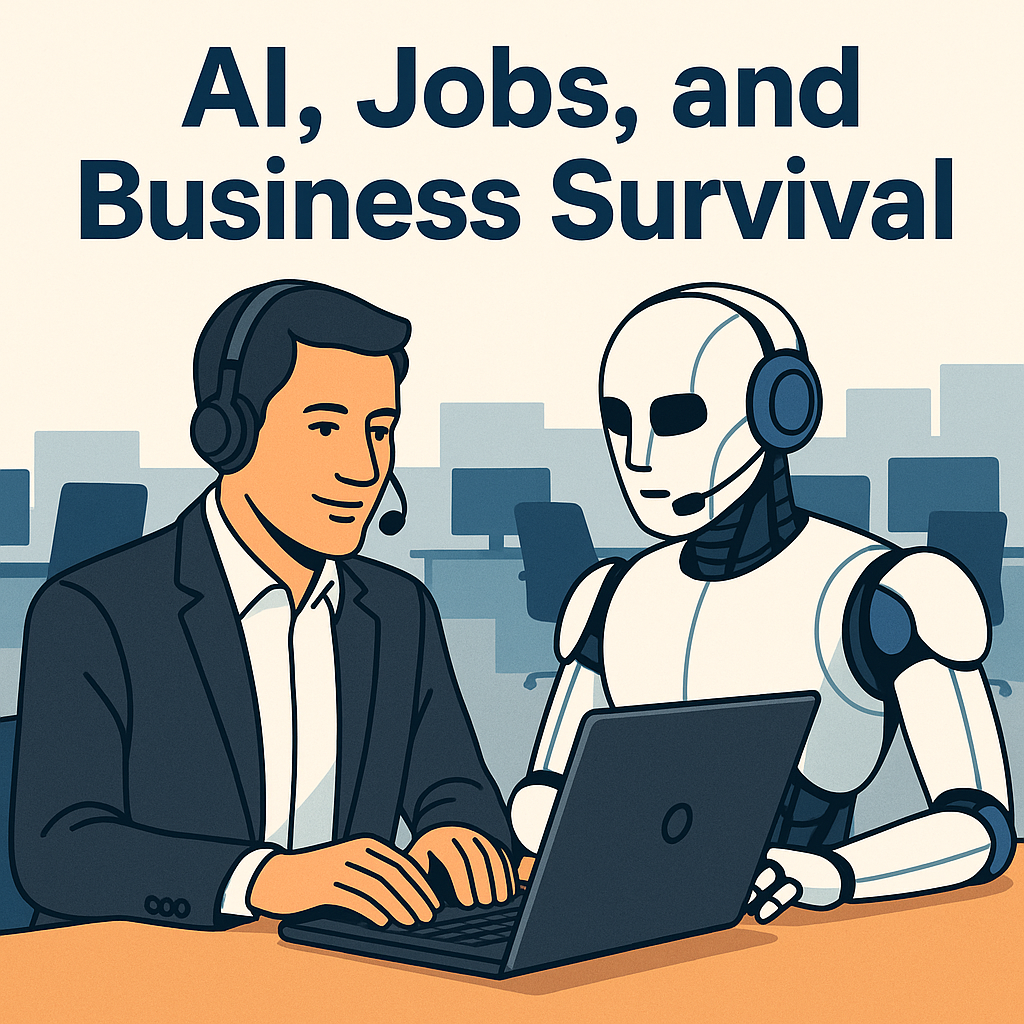
Cartoon of a contact center agent collaborating with a friendly AI robot at a laptop
AI and humans working side by side to elevate customer experience.

The Contact Center: Ground Zero for Change

Nowhere is this transformation more visible than in the modern contact center. For years, teams tried to balance efficiency with empathy. AI is changing the equation.

  • Amazon Q helps agents surface the best answer instantly.
  • Lex chatbots resolve common requests before they reach a live agent.
  • Bedrock Knowledge Bases keep bots and humans aligned to current policies, pricing, and procedures.

The result isn’t fewer agents—it’s freed agents, focused on complex conversations and relationships that drive loyalty and revenue.

From Job Loss to Job Lift

The fear of job loss is real, but the smarter narrative is job lift. As AI takes over repetitive tasks, teams can move up the value chain.

  • Agents evolve into AI orchestration specialists who manage digital + human workflows.
  • Supervisors shift from monitoring handle time to coaching customer outcomes.
  • Operations invests in journey design, data quality, and knowledge governance.

Responsible AI Is a Leadership Mandate

The debate is no longer whether to use AI—it’s how to use it responsibly.

  • Transparency: Be clear about where and how AI is assisting.
  • Retraining: Fund programs that help employees move up the value chain.
  • Governance: Maintain tight control over data sources and knowledge freshness.

Organizations that invest in responsible automation will not just survive—they’ll lead the next decade of growth.

Final Thoughts

AI isn’t the enemy of workers—it’s the next step in how we deliver value. The winners embrace automation as augmentation, not replacement.

If you’re ready to explore how Amazon Connect, Lex, Bedrock, and Q can modernize your customer experience, let’s talk.

📩 Email: Grace@DrVoIP.com
🔗 Website: DrVoIP.com
🎥 YouTube: @DrVoIP


About DrVoIP

DrVoIP helps organizations deploy AI-powered customer experience on AWS—fast. From Q for Connect and Lex chatbots to Bedrock Knowledge Bases and real-time analytics, we build practical automations that scale.


AI in Amazon Connect: How Bedrock, Lex, and SageMaker Work Together

Artificial Intelligence (AI) is transforming customer service — but figuring out how it actually fits into Amazon Connect can feel like drinking from a firehose. If you’ve heard about Amazon Bedrock, Lex, and SageMaker, and wondered which one you need (and when), this guide breaks it down in plain English.


🚀 The Big Picture: Smarter Contact Centers

Today’s contact centers are getting a serious AI upgrade. Instead of static IVR menus (“Press 1 for Sales”), companies are rolling out virtual agents that can answer customer questions, find information, and even summarize conversations for live agents.

Amazon Connect now offers multiple ways to build these smart assistants:

  • Amazon Lex – the conversational interface (your bot’s “voice” or “chat”).
  • Amazon Bedrock – access to powerful Large Language Models (LLMs) like Anthropic Claude or Amazon Titan.
  • Amazon SageMaker – the build-your-own lab for advanced machine learning models.
  • Amazon Q – a new generative AI assistant that plugs directly into Connect.

💡 When to Use Bedrock with a Knowledge Base

If your goal is to give customers or agents access to your company’s existing knowledge — like product FAQs, documentation, or policy manuals — then Bedrock with a Knowledge Base is your best friend.

This approach uses a technique called Retrieval-Augmented Generation (RAG). In simple terms, it means the AI doesn’t “make up” answers — it finds the relevant content in your data (from S3, SharePoint, Confluence, etc.) and uses that to respond accurately.

Example: a Lex bot built with Bedrock can answer questions like “What’s your return policy?” by pulling the answer straight from your latest documents, without anyone coding that response.

Why it works:

  • No need to train or fine-tune anything.
  • Updates automatically when you add new documents.
  • Secure – your data stays in AWS.
  • Low cost – you pay only for what you use.

🔬 When to Use SageMaker (Train Your Own Model)

On the other hand, Amazon SageMaker comes into play when you need something truly custom — like predicting call outcomes, detecting fraud, or creating a model that understands your company’s specific tone or workflow.

For instance, DoorDash uses a SageMaker model to detect fraud risk during customer claims, working alongside an Amazon Q bot that gathers call information. SageMaker models can also handle specialized tasks like classifying customer sentiment or summarizing long call transcripts.

Why it works:

  • Full control over how your model learns and behaves.
  • Ideal for predictive analytics or deep domain expertise.
  • Perfect for compliance-sensitive environments where you must control the model environment.

But: it’s more work. You’ll need data science skills, ongoing maintenance, and enough traffic to justify training costs.


⚖️ Quick Comparison

Feature Bedrock + Knowledge Base Custom Model (SageMaker)
Setup Plug-and-play, no training needed Full ML pipeline setup
Updates Auto-syncs with new data Requires retraining
Cost Pay-per-use Pay for compute time + hosting
Best For FAQs, self-service bots, knowledge lookup Predictions, analytics, custom use cases
Maintenance Low – managed by AWS High – you manage everything

🏗️ Recommended Architecture: Hybrid Wins

The smartest approach for most organizations? A hybrid strategy:

  1. Use Lex (or Amazon Q) with Bedrock Knowledge Base to handle FAQs, basic troubleshooting, and natural conversations.
  2. Let Bedrock access your private data using RAG to keep responses factual and up-to-date.
  3. When you need specialized tasks (like fraud scoring or call summarization), integrate SageMaker models via Lambda into your Connect flows.
  4. If the bot can’t resolve the issue, hand it off to a live agent — along with the AI-generated conversation summary.

This way, you combine the flexibility of managed AI with the power of custom intelligence — a true “AI assist” for both customers and agents.


🎯 The Bottom Line

For most Amazon Connect deployments, start simple: use Bedrock and Lex (or Amazon Q) with a Knowledge Base to create an intelligent, self-updating FAQ or customer assistant. Once you’re ready for advanced automation — like predictive scoring or call analytics — bring SageMaker into the mix.

Either way, the goal is the same: make every customer interaction faster, smarter, and more human.


💬 Need Help Bringing AI to Your Amazon Connect?

DrVoIP can help design and deploy AI-powered contact centers that combine the best of AWS — Connect, Lex, Bedrock, and SageMaker — to fit your business goals.

📧 Contact us at grace@drvoip.com or visit DrVoIP.com to get started.


Using AI in your Call Center?

Amazon Connect Meets AI

AI in the contact center isn’t new — it just has a new spotlight. Everyone’s talking about “adding AI” as if it were invented last year. The truth is, you’ve probably been using AI for years without realizing it. When your email automatically sorts spam, that’s artificial intelligence quietly doing its job. Not exactly ChatGPT or Grok, but definitely AI in action.

You’ve Already Been Using AI in Amazon Connect

If you’re running your customer engagement on Amazon Connect, you’re already using several AWS AI services without calling them that. For example:

  • Amazon Polly – Converts text to lifelike speech for system prompts and IVR messages.
  • Amazon Transcribe – Converts call recordings into searchable text for compliance and analysis.
  • Amazon Lex – Powers intelligent chatbots that understand and respond using Natural Language Processing (NLP).

These foundational tools are the AI engines that have been enhancing contact centers long before the hype cycle began.

Generative AI Takes the Agent Experience to the Next Level

With Amazon Q in Connect, agents now have a generative AI-powered assistant at their fingertips. Q delivers real-time guidance, next-best actions, and even step-by-step workflows customized to each customer interaction. After the call ends, it automatically generates contact summaries—cutting down After Contact Work (ACW) from minutes to seconds.

This shift doesn’t replace agents—it empowers them to spend more time solving real customer problems and less time clicking through systems.

From Chatbots to Knowledge Bots

At DrVoIP, we help design and implement next-generation contact centers that extend agent capability with intelligent knowledge systems. Using Amazon Bedrock, we can train and connect foundation models like ChatGPT, Anthropic Claude, Meta Llama, or Nova to your company’s own data sources. That means both bots and agents can instantly access your unique knowledge base—product details, service FAQs, policy documents, and more.

Imagine a chatbot that can check an order status, or an agent that can instantly pull a precise policy answer—all through AI securely integrated with your business systems.

Let’s Build Your AI-Ready Contact Center

As an AWS Certified Partner, DrVoIP specializes in Amazon Connect design, deployment, and ongoing optimization. We bring deep expertise in integrating AI services across AWS—from Lex and Q to Bedrock and beyond—so you can turn your contact center into a true customer experience engine.

AI isn’t the future—it’s already here. The only question is whether your contact center is ready to use it to its full potential.

Ready to see what’s possible? Contact Grace@DrVoIP.com to explore your AI-powered Connect deployment today.